CITAS is the field on a Costa Rica Registro Nacional certificate that gives the registry reference of the document behind an entry: the deed, administrative resolution or court filing that created it. It tells you where an entry came from, not what the document says. Your next step is to have your attorney pull and read that underlying document.
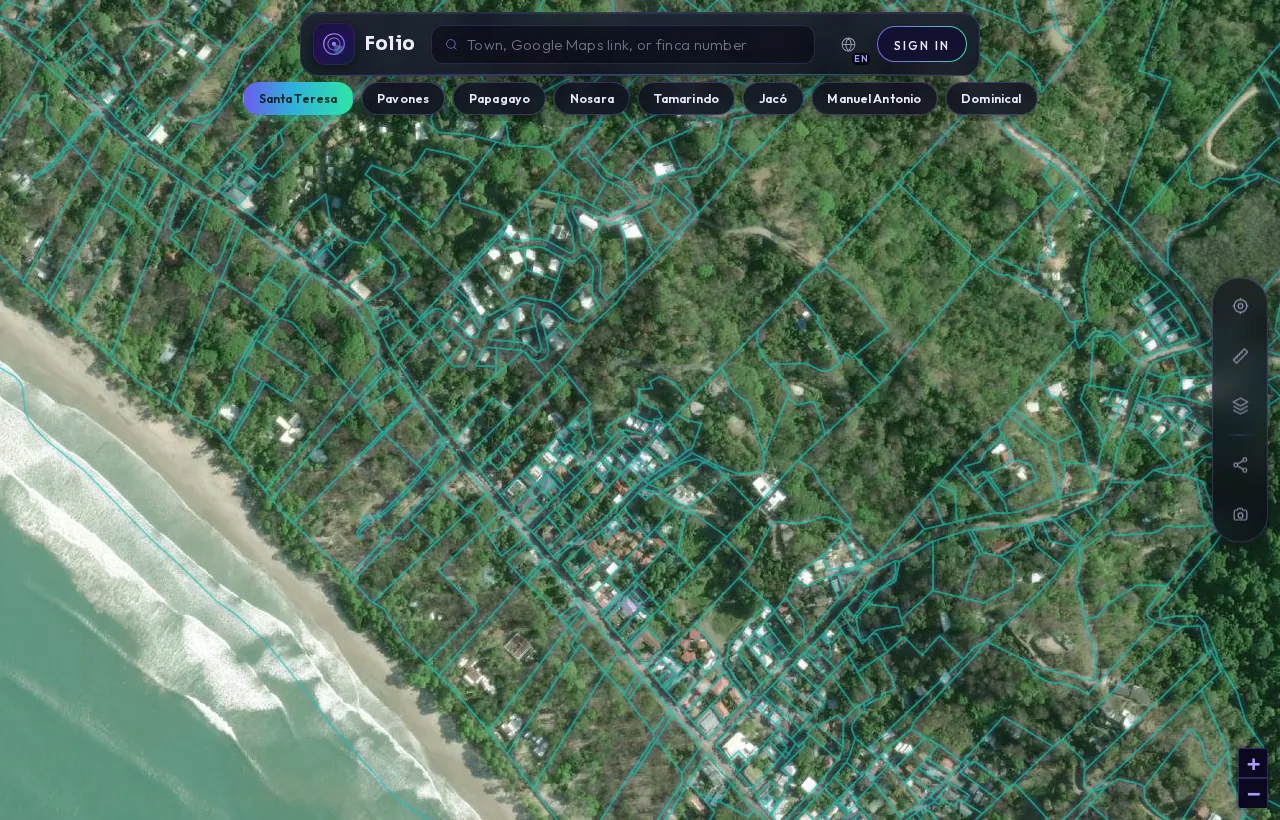
Any parcel, in the Folio app.
Search a town, a Google Maps link or a finca and Folio outlines the registered parcel from the national cadastre, with the maritime line, protected areas and water on top of it, before you call a lawyer or put down a deposit.
What turned up in our recent certificates
These counts come from 9 Folio verified reports pulled in September and October 2026, a small sample and not a national rate.
What does CITAS mean on a registry certificate?
CITAS appears on a certificación literal, which is the full certified extract of a property record from the Registro Nacional. It is the field that gives the registry reference of the document behind an entry. That document might be a deed signed before a notary, an administrative resolution or a court filing. In short, CITAS answers one question: where did this entry come from?
The word itself means "citations" or "references" in Spanish. It is not a warning, a debt or a legal status. It is a pointer. You will find it inside the entries listed on the certificate, next to the details of each easement, reservation, annotation or other item recorded against the finca (the registered property).
Where does CITAS sit on the certificate?
CITAS only makes sense in context, so it helps to know how the certificate is laid out. The certificates Folio pulls for its verified reports follow the same order:
- A description of the finca itself. This covers NATURALEZA (what the property is, for example a lot for building), location, LINDEROS (boundaries described by what lies to the north, south, east and west), area, PLANO (the cadastral survey plan number linked to the finca), IDENTIFICADOR PREDIAL (a parcel identifier code), VALOR FISCAL (a fiscal value in colones) and the owner.
- A block headed ANOTACIONES SOBRE LA FINCA, for annotations recorded on the property as a whole.
- A block headed GRAVAMENES o AFECTACIONES, for gravámenes (encumbrances) and afectaciones (limitations affecting the property).
Inside each block, every entry starts with a heading line that names its type. Examples include SERVIDUMBRE DE PASO (right-of-way easement), RESERVAS LEY FORESTAL and INMOVILIZACION POR INCONSISTENCIA. The CITAS field belongs to that entry.
One point to keep straight: NATURALEZA describes the finca, not the encumbrance. The heading line tells you what kind of entry you are reading. If you want to see the plan that PLANO refers to, our guide on what a plano catastrado is explains how the survey and the registry record relate.
Which other fields sit next to CITAS?
CITAS is part of a larger entry. Depending on the type of entry, some of these labels may appear around it:
- AFECTA A FINCA: the finca the entry affects.
- A FAVOR DE LA(S) FINCA(S) and EN CONTRA DE LA(S) FINCA(S): for an easement, the property that benefits and the property that carries the burden.
- LONGITUD, ANCHO and RUMBO: the length, width and direction of an easement strip.
- MONTO: an amount stated in the entry. In Folio's sample it appeared on easements, as a nominal value, and on a lawsuit annotation.
- INICIA EL and FINALIZA EL: start and end dates, where the entry has them.
- CANCELACIONES PARCIALES: whether part of the entry has been cancelled.
- ANOTACIONES DEL GRAVAMEN: notes recorded against that specific entry, separate from notes on the finca as a whole.
Read together, these fields summarize the entry. CITAS tells you which source document holds the full story.
What kinds of entries appeared in Folio's recent reports?
Here is what showed up in Folio's paid verified reports from September and October 2026, so you can see the kinds of entries that appeared in this sample. This is a small sample of 9 reports. It is not a national rate and should not be read as one.
Of the 9 certificates, 8 (89%) had at least one entry under GRAVAMENES o AFECTACIONES. 3 (33%) had something under ANOTACIONES SOBRE LA FINCA, and these overlap with the 8. Only 1 (11%) had neither.
| Entry type (heading line) | Reports | Share of the 9 |
|---|---|---|
| Servidumbre, any kind of easement | 4 | 44% |
| Servidumbre de paso (right of way) | 3 | 33% |
| Reservas y restricciones carried from an older parent finca | 3 | 33% |
| Inmovilización por inconsistencia (registry freeze) | 2 | 22% |
| Advertencia administrativa (administrative warning) | 2 | 22% |
| Servidumbre de vista (view easement) | 1 | 11% |
| Reservas Ley de Aguas (water law reservation) | 1 | 11% |
| Reservas Ley de Caminos (roads law reservation) | 1 | 11% |
| Reservas Ley Forestal (forestry reservation) | 1 | 11% |
| Afectaciones y limitaciones Ley Forestal 7575 | 1 | 11% |
| Demanda (lawsuit annotation) | 1 | 11% |
| Obligaciones (registered obligations) | 1 | 11% |
A single certificate can carry several of these, so the rows do not add up to 9. In the ANOTACIONES SOBRE LA FINCA block, the sample included three kinds of item. There was a sale deed presented to the registry but not yet fully recorded, there were administrative warnings, and there were registry freezes whose text cites an administrative file (expediente). Each one points back to a document, and pointing to that document is exactly what CITAS is for.
Check a lot's cadastre, maritime zone and protected areas in the free app.
Check it freeWhat does CITAS not tell you?
This is the key limit to understand. CITAS is a reference, not a summary. On its own it does not tell you:
- The full wording of the deed, resolution or court filing behind the entry.
- Whether an easement is actually used on the ground, or where the strip physically runs compared with the survey.
- Whether a reservation carried down from an older parent finca still has any practical effect on your lot.
- How a lawsuit annotation is progressing, or whether a freeze over an inconsistency has been resolved.
- Whether an entry is legally relevant to your plans for the property.
Generic entries such as reservas y restricciones are a good example. They can look alarming, but in this sample they were carried from an older parent finca. Ask your attorney whether such a reservation still has any practical effect. SEGREGACIONES only shows whether lots have been split off from this finca, so ask your attorney to trace where an inherited reservation came from.
Other entries, like an inmovilización, are registry freezes. Ask your attorney whether one would stop a transfer from being recorded. The CITAS line looks the same in both cases. Only the underlying document, read by someone qualified, tells you which kind you are dealing with.
Get the free Costa Rica buyer's checklist
What to ask for, what to pull from the registry and what to confirm on the map before you sign anything. One short email, no spam.
How can you follow a CITAS reference?
The Registro Nacional offers certificates and registry consultations through its digital service at rnpdigital.com. Our walkthrough on how to search the Costa Rica property registry yourself covers the basic consultation. Retrieving and interpreting the source document behind a CITAS reference is usually a job for your attorney or notary. They know where that document is kept and how to read it.
When the entry is a demanda, the underlying case sits with the courts. The Poder Judicial is the place to look. Your attorney is the right person to confirm the status of the case and what it means for a purchase. For an inmovilización, the entry text in this sample cited an administrative file (expediente), and that file is where the inquiry starts. For an advertencia administrativa, ask your attorney which file or resolution it rests on.
Which question should you put to your attorney?
Do not ask "is this property clean?" Ask something narrower that forces a document-level answer. For each entry on the certificate, a useful question is:
"For this entry, have you pulled and read the document referenced under CITAS, and what does it actually require of, or allow on, this property?"
From there, follow up based on the type of entry:
- Easement: which finca benefits, where does the strip run, and does it match the survey plan and the ground?
- Reservation: is this a generic inherited reservation, or does it limit what I can build, cut or use, especially around water, roads or forest?
- Freeze, warning or lawsuit: can the sale be recorded while this entry stands, and what has to happen before closing?
- Deed presented but not fully recorded: what is pending, and how does it affect the transfer to me?
Ask your attorney to confirm which rule applies in each case. The registry shows what has been recorded. The legal effect is their call.
How a Folio report fits in
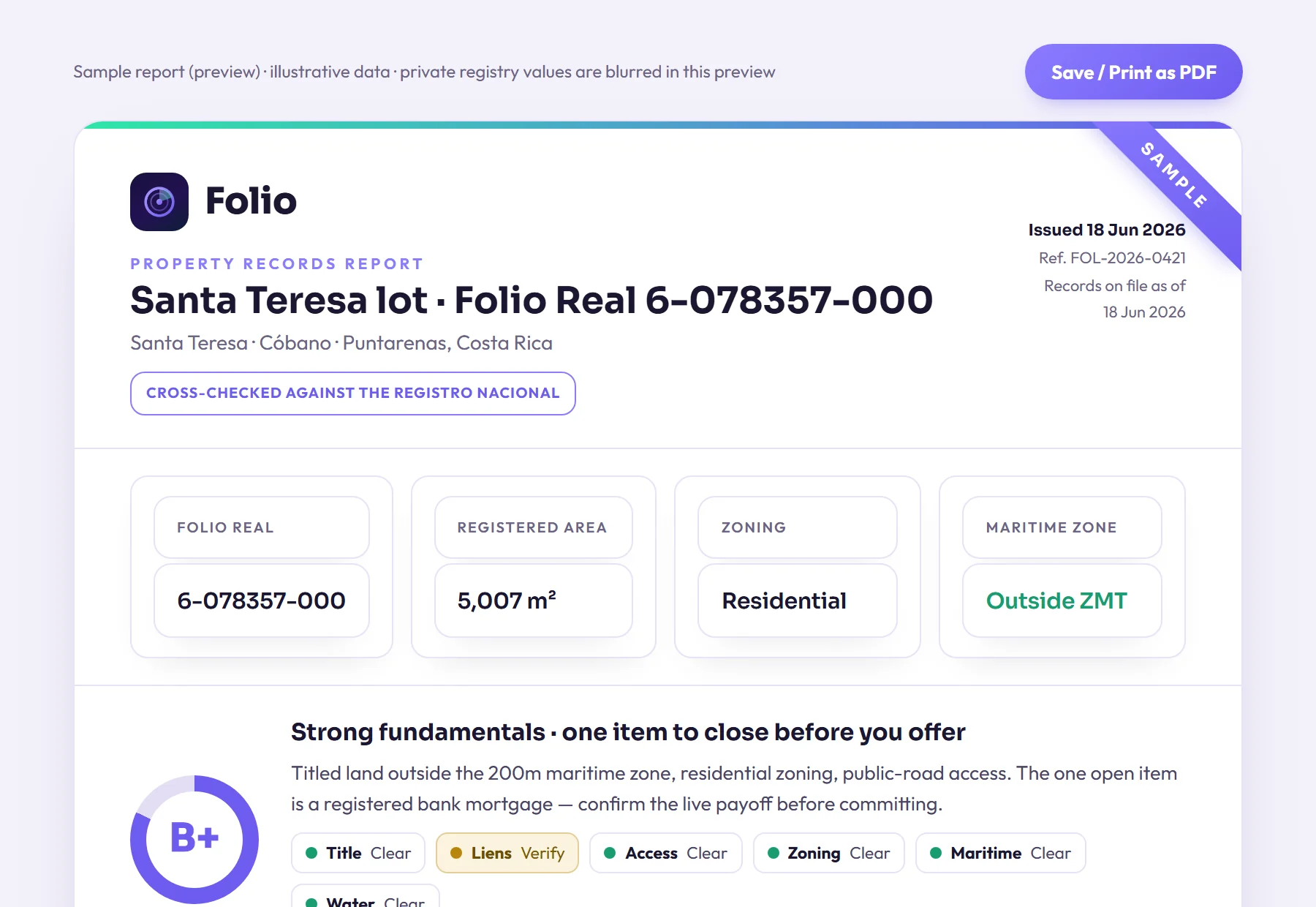
A Folio verified report costs $29 and is delivered within 24 hours. It is a human-checked title and records search covering the registered owner, liens, taxes, water rights and the exact maritime line. It helps you see which recorded entries to raise with your attorney. You can see the full scope in what a Folio property report includes. The report tells you what the public record says, so your conversation with your lawyer starts from the right documents. It does not replace that lawyer.
Know what you're buying before the deposit.
Most problems with a lot don't show up in the listing, and often the seller doesn't know about them either. Folio lets you find them now, before you pay a lawyer to start the purchase.
Frequently asked questions
Is CITAS the same as a lien?
No. CITAS is a reference field inside an entry, and it points to the document behind that entry. The entry's heading line tells you whether it is an easement, a reservation, an annotation, an obligation or something else.
Does every entry under GRAVAMENES o AFECTACIONES matter equally for a purchase?
Not necessarily. Some generic reservations are inherited from an older parent finca. For others, such as a registry freeze, ask your attorney whether they affect whether a transfer can be recorded. Your attorney should read the document referenced under CITAS for each entry before you decide.
How common are encumbrances in Folio's reports?
In a small sample of 9 Folio verified reports from September and October 2026, 8 had at least one entry under GRAVAMENES o AFECTACIONES. Only 1 had no entries in either block. Treat this as a small sample, not a national rate.
Can I read the document behind a CITAS reference myself?
Certificates and registry consultations are available through the Registro Nacional's digital services. Locating and interpreting the underlying deed, resolution or court file is usually best left to your attorney or notary. They can also tell you what the document means for your purchase.
Sources
- Registro Nacional digital services (certificaciones and registry consultations), Registro Nacional de Costa Rica
- Poder Judicial de Costa Rica, Poder Judicial
- Folio data: Registro Nacional certificates pulled for recent paid Folio reports, aggregated and anonymized.
Educational, not legal advice. Folio reports what public records show; it does not replace a licensed Costa Rican attorney, notary or surveyor. Confirm material facts with them before any transaction. Photos are illustrative.