The gravámenes section of a Costa Rica title, labelled GRAVAMENES o AFECTACIONES on the registry certificate, lists the burdens and limitations registered against the property, such as easements, legal reservations and registered obligations. Read each entry by its type, its CITAS (the registry reference), whether it runs in favour of or against the finca, and its dates or amount. Then review the separate ANOTACIONES SOBRE LA FINCA section for items such as registry freezes, administrative warnings or documents not yet fully recorded. Have your attorney explain what each entry means for your intended use.
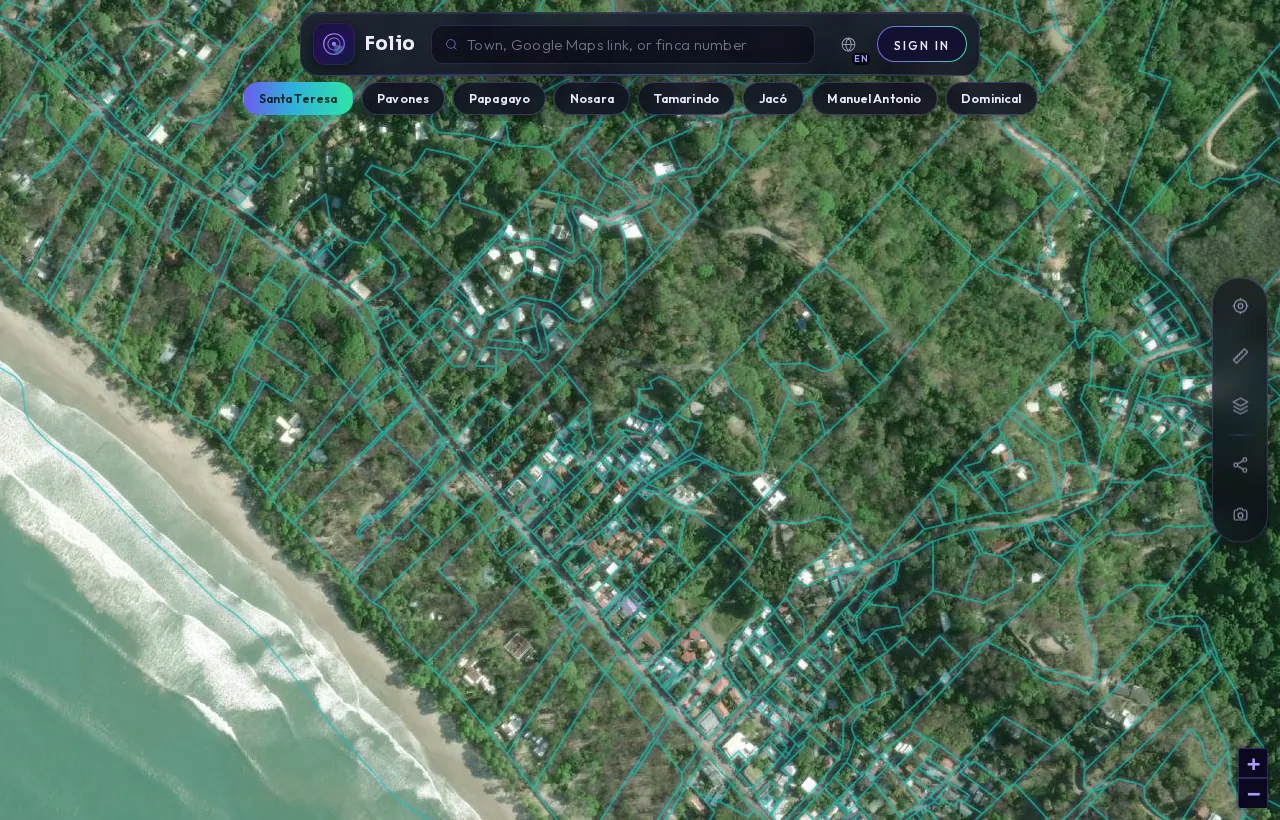
Any parcel, in the Folio app.
Search a town, a Google Maps link or a finca and Folio outlines the registered parcel from the national cadastre, with the maritime line, protected areas and water on top of it, before you call a lawyer or put down a deposit.
What turned up in our recent reports
Counts come from a small sample of 9 paid Folio reports over two recent months, so read them as a sample, not a national rate.
The gravámenes section is where a Costa Rica title tells you what else has a claim on, or a limit over, the land. It does not tell you whether that matters for your plans. Reading it well means separating routine entries from the ones that need a lawyer's opinion before you sign anything.
This guide uses the actual field labels that appear on the certificates Folio pulls from the Registro Nacional. If you have never looked at one, start with our guide on how to check a property title in Costa Rica, then come back here.
What is the gravámenes section of a Costa Rica title?
Every registered property (a finca) has a record at the Registro Nacional. When you order a certificación literal (a full certified copy of that record), the property's details come first: the NATURALEZA (description of the land), LINDEROS (boundaries), PLANO (the cadastral survey reference), IDENTIFICADOR PREDIAL and VALOR FISCAL (a fiscal value recorded on the registry, in colones). After those comes a block headed ANOTACIONES SOBRE LA FINCA, and then a block headed GRAVAMENES o AFECTACIONES.
Gravámenes means encumbrances. Afectaciones means limitations or effects on the property. Together they cover anything registered that burdens the land or restricts what an owner can do with it. On some records the section shows nothing. On others it lists entries, some of them carried over from an older parent finca.
Which field labels will you see inside each entry?
Each entry in the section is a small record of its own. These are the labels Folio has seen on the certificates behind its recent reports, with what they generally indicate:
- CITAS: the registry reference of the document (deed, resolution or court filing) behind the entry. Your attorney can use it to look up that document.
- A FAVOR DE LA(S) FINCA(S): for an easement, the property that benefits. This is the land that gets the right.
- EN CONTRA DE LA(S) FINCA(S): for an easement, the property that carries the burden.
- AFECTA A FINCA: which finca the entry affects.
- INICIA EL and FINALIZA EL: start and end dates, where the entry has them.
- MONTO: an amount stated in the entry. In Folio's sample it appeared on easements (a nominal value) and on a lawsuit annotation.
- ANCHO, LONGITUD and RUMBO: width, length and direction of an easement strip.
- ANOTACIONES DEL GRAVAMEN: notes recorded against that specific entry.
- CANCELACIONES PARCIALES: whether part of the entry has been cancelled.
The single most important thing to confirm on any easement is direction. If your target finca appears under A FAVOR DE, it holds a right over someone else's land. If it appears under EN CONTRA DE, someone else holds a right over yours. The same word, servidumbre, can be good news or a constraint depending on which side of that line you are on.
What kinds of entries turn up in practice?
Folio pulled a certificación literal for each paid report over two recent months. That is a small sample: 9 reports. It is not a national rate and should not be read as one, but in this sample most certificates had something in this section.
Of those 9 reports, 8 (89%) had at least one entry under GRAVAMENES o AFECTACIONES. Only 1 (11%) had no gravámenes and no anotaciones at all. Three reports (33%) had items in the separate ANOTACIONES SOBRE LA FINCA section, covered below.
| Entry type seen | Reports | Share of 9 |
|---|---|---|
| Servidumbre of any kind (easement) | 4 | 44% |
| Servidumbre de paso (right-of-way easement) | 3 | 33% |
| Reservas y restricciones (generic reservations from an older parent finca) | 3 | 33% |
| Inmovilización por inconsistencia (registry freeze over an inconsistency) | 2 | 22% |
| Advertencia administrativa (administrative warning) | 2 | 22% |
| Servidumbre de vista (view easement) | 1 | 11% |
| Reservas Ley de Aguas (water law reservation) | 1 | 11% |
| Reservas Ley de Caminos (roads law reservation) | 1 | 11% |
| Reservas Ley Forestal (forestry reservation) | 1 | 11% |
| Afectaciones y limitaciones Ley Forestal 7575 (forest protection limitation) | 1 | 11% |
| Demanda (lawsuit annotation) | 1 | 11% |
| Obligaciones (registered obligations) | 1 | 11% |
A single report can contain several entry types, so the rows overlap and do not add up to 9.
Reservations inherited from a parent finca
Entries labelled reservas y restricciones are generic reservations carried over from an older parent finca. Others are reservations under the water, roads or forestry laws. A forestry reservation, for example, can prohibit cutting trees. You cannot tell what practical effect an entry has from the label alone, which is why the CITAS reference matters.
Check the official maps for a lot you like in the free Folio app.
Check it freeHow is ANOTACIONES SOBRE LA FINCA different from gravámenes?
Gravámenes are burdens that have been registered. Anotaciones (annotations) sit in their own block, headed ANOTACIONES SOBRE LA FINCA. In Folio's small sample, that block held a sale deed presented to the registry but not yet fully recorded, administrative warnings, and registry freezes. Ask your attorney about each one.
In Folio's small sample, the items that showed up here or alongside it included registry freezes over an inconsistency, administrative warnings and a lawsuit annotation. In this sample, the text of each freeze (inmovilización) cited an administrative file (expediente). If you see a freeze or an administrative warning (advertencia administrativa), ask your attorney what caused it and whether it can be resolved. A demanda annotation tells you a lawsuit concerning the property has been noted on the record. If you see one, ask your attorney whether the case can be looked up through the Poder Judicial using the reference on the certificate.
It also helps to understand the survey side of the record. Our guide to the plano catastrado explains what the cadastral map is and how it links to the title.
Get the free Costa Rica buyer's checklist
What to ask for, what to pull from the registry and what to confirm on the map before you sign anything. One short email, no spam.
What does the gravámenes section not tell you?
The section is a list of registered entries. It reflects what has been recorded, but it is silent on a lot of things a buyer cares about:
- Whether a burden still matters. An old reservation may be obsolete or very much alive. The certificate does not say.
- Where an easement physically runs. ANCHO, LONGITUD and RUMBO describe it in words. They do not show you whether the strip crosses your planned building site.
- Unregistered claims. A neighbour's informal access, an unpaid contractor or an agreement that was never recorded will not appear.
- Current balances. MONTO shows an amount stated in the entry. It does not tell you what, if anything, is owed today.
- Zoning, environmental and maritime rules that are not written into the finca record. Protected areas, water features and the maritime zone are mapped elsewhere.
- Whether you can get a permit or resell. Nothing on the certificate answers that.
An empty gravámenes section is a good start, not a clean bill of health. And a full one is not automatically a reason to walk away: in Folio's small sample, 8 of 9 reports had at least one entry.
Which questions should you put to your attorney?
Bring the certificate to your attorney or notary and ask about each entry by its CITAS reference. Useful questions include:
- For each servidumbre, is this property the beneficiary (A FAVOR DE) or the burdened land (EN CONTRA DE), and where does the strip run on the ground?
- Do any of the reservations, especially water, roads or forestry, limit building, clearing or access for what I plan to do?
- Is any registered obligation still active, and how would it be dealt with before or at closing?
- Are there any anotaciones, freezes or warnings, what caused them, and can they be resolved before transfer?
- If there is a demanda annotation, what is the case about and how could its outcome affect ownership?
- Do the title and the cadastral survey match, and are there any SEGREGACIONES (lots split off) that change the area I am buying?
Ask your attorney to confirm which legal rules apply to each entry. The registry shows what was recorded; the legal effect is a matter for professional advice.
Where do you get the certificate to read?
You can order a certificación literal yourself through the Registro Nacional's digital services portal. Our guide on how to search the Costa Rica property registry yourself walks through the search and what the results look like.
Read the certificate in the order it is laid out: the property's details first, then ANOTACIONES SOBRE LA FINCA, then the GRAVAMENES o AFECTACIONES block. Write down every CITAS reference. Those references are what turn a confusing list into specific questions your lawyer can answer.
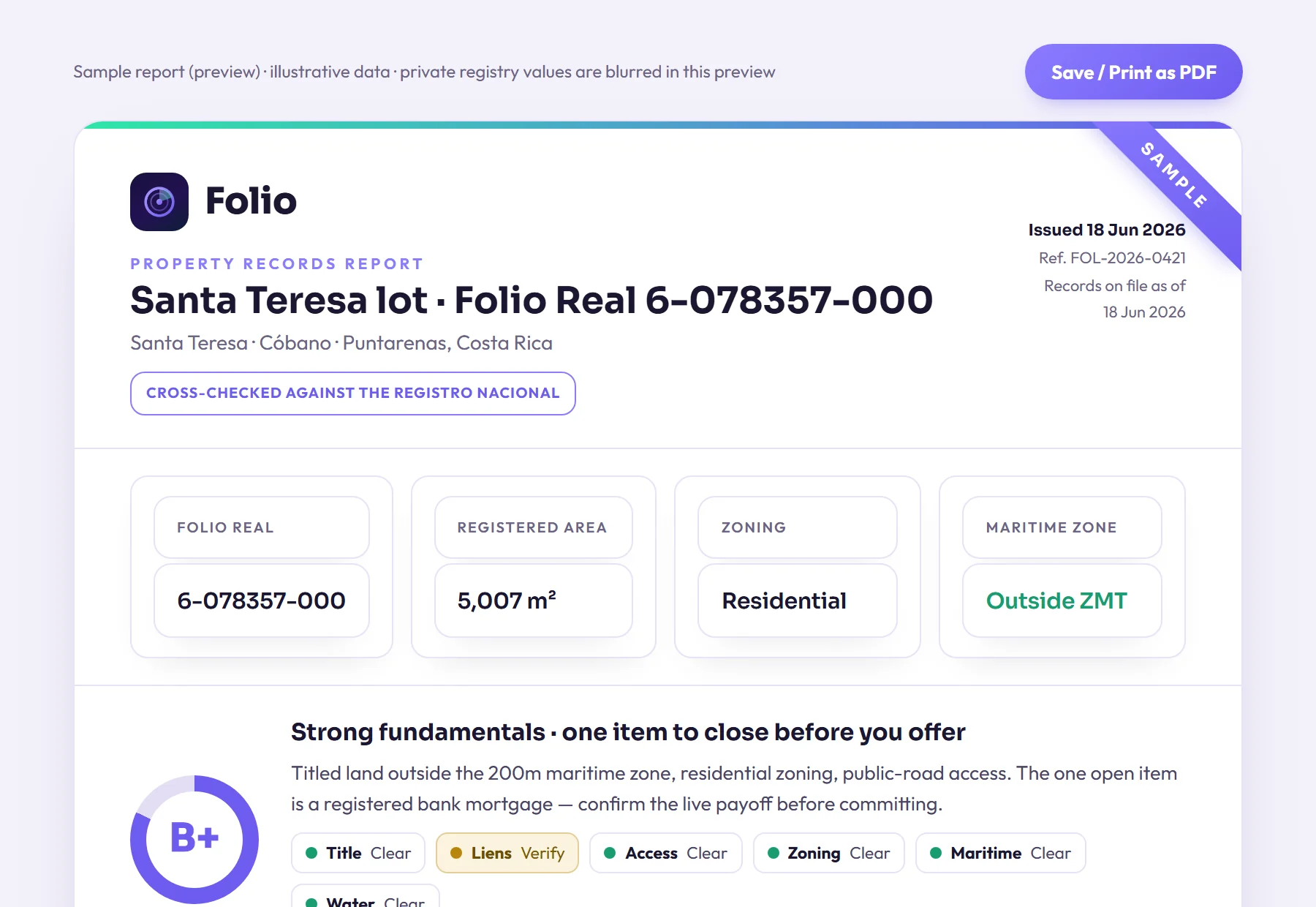
Know what you're buying before the deposit.
Most problems with a lot don't show up in the listing, and often the seller doesn't know about them either. Folio lets you find them now, before you pay a lawyer to start the purchase.
Frequently asked questions
What does "gravámenes" mean on a Costa Rica property title?
Gravámenes means encumbrances: burdens registered against a property, such as easements, registered obligations and legal reservations. On the registry certificate they appear under the heading GRAVAMENES o AFECTACIONES, together with limitations on how the land can be used.
Is it a bad sign if the gravámenes section is not empty?
Not necessarily. In Folio's small sample of 9 recent reports, 8 had at least one entry. Easements appeared in 4, and reservations carried from an older parent finca appeared in 3. What matters is what each entry means for your plans, which your attorney can explain.
What is the difference between gravámenes and anotaciones?
Gravámenes are burdens that have been registered on the finca. Anotaciones are shown in a separate block, ANOTACIONES SOBRE LA FINCA. In Folio's small sample, that block held a sale deed presented to the registry but not yet fully recorded, registry freezes and administrative warnings. Ask your attorney about each one.
How can I tell if an easement benefits or burdens the property?
Look at the A FAVOR DE LA(S) FINCA(S) and EN CONTRA DE LA(S) FINCA(S) fields. If the property you are buying is listed in favour, it holds the right over other land; if it is listed against, another property holds a right over it.
Does an empty gravámenes section mean the property has no problems?
No. The section only shows what has been registered. Unrecorded claims, zoning and environmental rules, physical access issues and title and survey mismatches may not appear there, so have an attorney review the full picture before you commit.
Sources
- Registro Nacional digital services (certificaciones and registry consultations), Registro Nacional de Costa Rica
- Poder Judicial de Costa Rica, Poder Judicial
- Folio data: Registro Nacional certificates pulled for recent paid Folio reports, aggregated and anonymized.
Educational, not legal advice. Folio reports what public records show; it does not replace a licensed Costa Rican attorney, notary or surveyor. Confirm material facts with them before any transaction. Photos are illustrative.