An inmovilización por inconsistencia is a registry freeze placed on a Costa Rica finca (registered property) because the Registro Nacional has flagged an inconsistency in its records. In the freezes in our small sample of reports, the entry cited an administrative file, or expediente. Treat it as a stop sign: before you sign or pay anything, your attorney should pull that file, find out what the inconsistency is, and confirm what the freeze prevents and how it can be lifted.
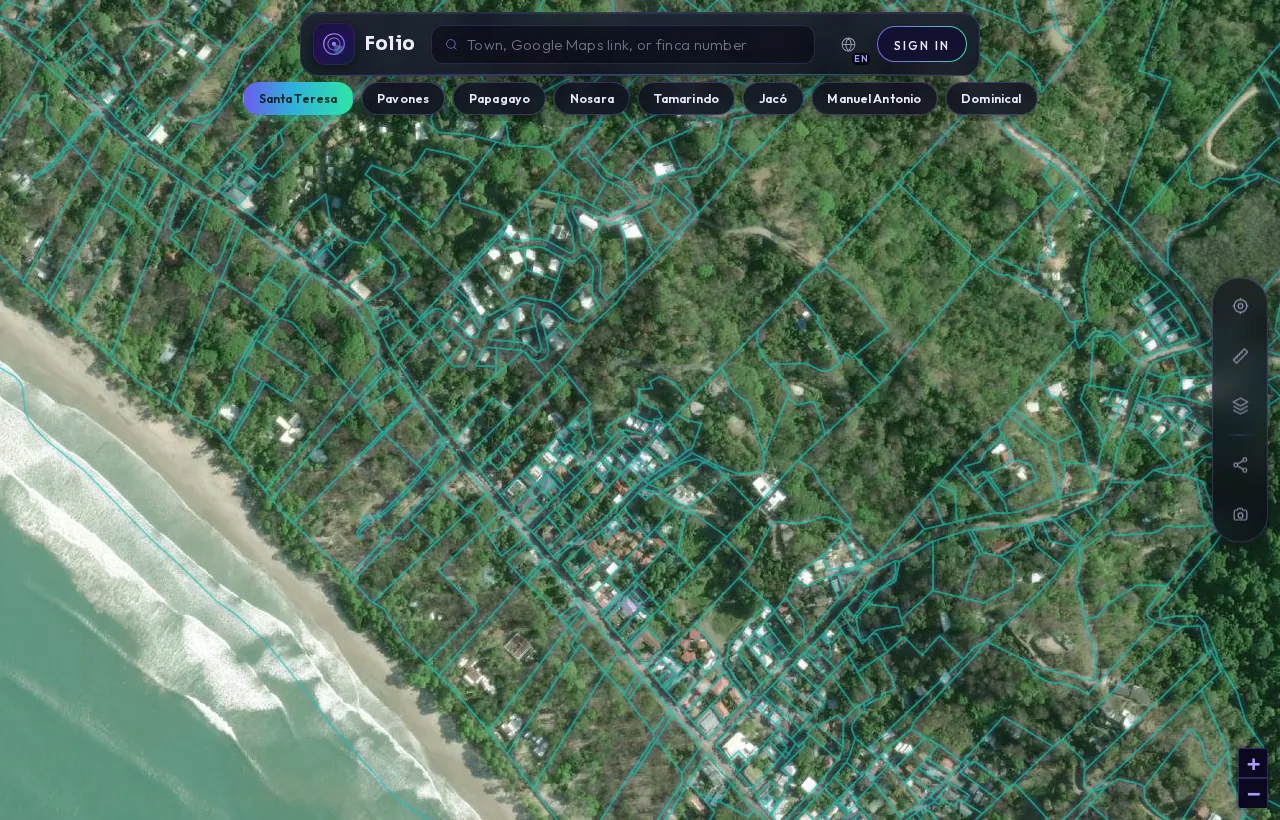
Any parcel, in the Folio app.
Search a town, a Google Maps link or a finca and Folio outlines the registered parcel from the national cadastre, with the maritime line, protected areas and water on top of it, before you call a lawyer or put down a deposit.
What turned up in our recent reports
Counts come from a small sample of recent paid Folio reports, so read them as a snapshot and never as a national rate.
What is an inmovilización por inconsistencia?
An inmovilización por inconsistencia is a freeze recorded on a title because the registry has found something in the record that does not line up. The inconsistency could involve the property's own entries, the documents behind them, or how a previous transaction was recorded. The entry tells you a problem has been flagged. It does not, on its own, tell you who is at fault or how serious the problem is.
For a buyer, the practical meaning is simple. The title is not in a normal, clean state, and the freeze entries we saw cite an administrative file about it. Until that file is understood, you do not know whether the seller can actually deliver the property you are paying for.
The exact legal effect of a freeze, and the route to lifting it, depend on the rules that apply and on what the expediente says. We have no verified official text to quote on that here, so ask your attorney to confirm which rule applies to the specific entry and what it blocks.
How often did freezes appear in the reports we checked?
We reviewed the anonymized certificaciones literales (full registry certificates) pulled from the Registro Nacional for each paid Folio verified report over two recent months. That is a sample of 9 reports. It is small, and it comes from people who chose to order a report, so it says nothing about a national rate. What it does show is that these entries appeared even in this small set of reports.
| What the certificate showed | Reports | Share of the sample |
|---|---|---|
| Any entry under GRAVAMENES o AFECTACIONES (encumbrances or affectations) | 8 | 89% |
| Any entry under ANOTACIONES SOBRE LA FINCA (annotations on the property) | 3 | 33% |
| Inmovilización por inconsistencia (registry freeze) | 2 | 22% |
| Advertencia administrativa (administrative warning) | 2 | 22% |
| Demanda (lawsuit annotation) | 1 | 11% |
| No encumbrances and no annotations at all | 1 | 11% |
Two points stand out. First, a completely bare title was the exception: only 1 of the 9 had no entries in either block. Easements appeared on 4 of the 9, and reservations carried from an older parent finca on 3. Second, 2 of the 9 certificates carried a registry freeze. Even in a small sample, that is a reminder to read the certificate line by line.
Where does a freeze appear on the certificate?
A certificación literal follows a fixed layout. It first describes the finca itself: NATURALEZA (what the property is, for example a lot for building), LINDEROS (boundaries to the north, south, east and west), area, PLANO (the cadastral survey plan), IDENTIFICADOR PREDIAL (a parcel identifier), VALOR FISCAL (a fiscal value in colones) and the registered owner. Then come two blocks.
- ANOTACIONES SOBRE LA FINCA (annotations on the property). In our sample this block held three kinds of entries: a sale deed presented to the registry but not yet fully recorded, administrative warnings, and registry freezes.
- GRAVAMENES o AFECTACIONES (encumbrances or affectations). This is where easements, reservations carried from an older parent finca, forestry limitations, lawsuit annotations and registered obligations appeared.
Each entry starts with a heading line naming its type, such as INMOVILIZACION POR INCONSISTENCIA or SERVIDUMBRE DE PASO. Read that heading, not the NATURALEZA field. NATURALEZA describes the property, not the entry.
The most useful field on a freeze is CITAS, the registry reference of the document behind it. In the freezes we saw, the text cited an administrative file (expediente). That reference is what your attorney uses to request the file and read the actual reasoning. Without it, you are guessing.
How is an advertencia administrativa different?
An advertencia administrativa (administrative warning) is a separate kind of entry from a freeze, with its own heading line. What each one means in law, and how much weight it carries compared with a freeze, is something your attorney should confirm from the cited file.
In everyday terms, read either one as a sign to look closely before you rely on the record. Each appeared on 2 of the 9 certificates in our sample. Neither should be waved away as paperwork. Whether a warning limits new recordings, and how it relates to any freeze on the same property, is a question for your attorney, who can read the cited file.
Check any Costa Rica lot against official map layers in the free Folio app.
Check it freeWhy would a registry flag an inconsistency at all?
Registries flag inconsistencies when the record contradicts itself or contradicts the documents filed. Our data does not show what caused the freezes we saw. Ask your attorney whether the cause is clerical, such as a mismatch between a deed and the survey plan, or something more serious, such as a transfer that may not have been properly authorized. Our guide to Costa Rica property title fraud explains why a flagged record deserves extra scrutiny when the seller is pushing for speed.
You cannot tell which kind of problem you have from the heading line alone. That is why the expediente matters more than the label.
Get the free Costa Rica buyer's checklist
What to ask for, what to pull from the registry and what to confirm on the map before you sign anything. One short email, no spam.
Can you still buy a property whose title is frozen?
Do not assume you can. A freeze means the record is in a state the registry itself considers unresolved, and you may not be able to register your purchase while it stands. Paying a deposit or signing a purchase agreement before the freeze is explained puts your money at the mercy of a process you have not read.
Some freezes may be resolved, and a property with a history of one is not automatically a bad purchase. But resolution is a legal and administrative matter, and it has to be confirmed in the record, not promised by a seller or an agent. A notary or attorney should tell you whether, and on what conditions, a transaction can go forward. If you are weighing whether to hire one, read do you need a lawyer to buy property in Costa Rica.
What should you do if you find one?
- Get a current certificación literal, not a screenshot or an old printout from the seller. You can request certificates and registry consultations through the Registro Nacional's digital services.
- Copy the full text of the freeze entry, including CITAS and any expediente reference.
- Check the rest of the ANOTACIONES block. A freeze sitting next to an unrecorded sale deed or a warning tells a different story than a freeze alone.
- Look for a demanda (lawsuit annotation). If there is one, ask your attorney whether the case can be looked up through the Poder Judicial.
- Ask your attorney to obtain and read the expediente and explain, in writing, what the inconsistency is, what the freeze blocks, and what has to happen before it is lifted.
- Discuss with your attorney holding payments until that answer is in hand and the record reflects it.
If you have never read a certificate before, our walkthrough on how to check a property title in Costa Rica covers the whole document, not just the annotations.
What our sample cannot tell you
Nine reports is a snapshot, not a survey. We cannot say how common freezes are nationwide, which regions see more of them, how long they typically last, or how often they are lifted. We also do not describe any individual property, and we never link a finding to a location.
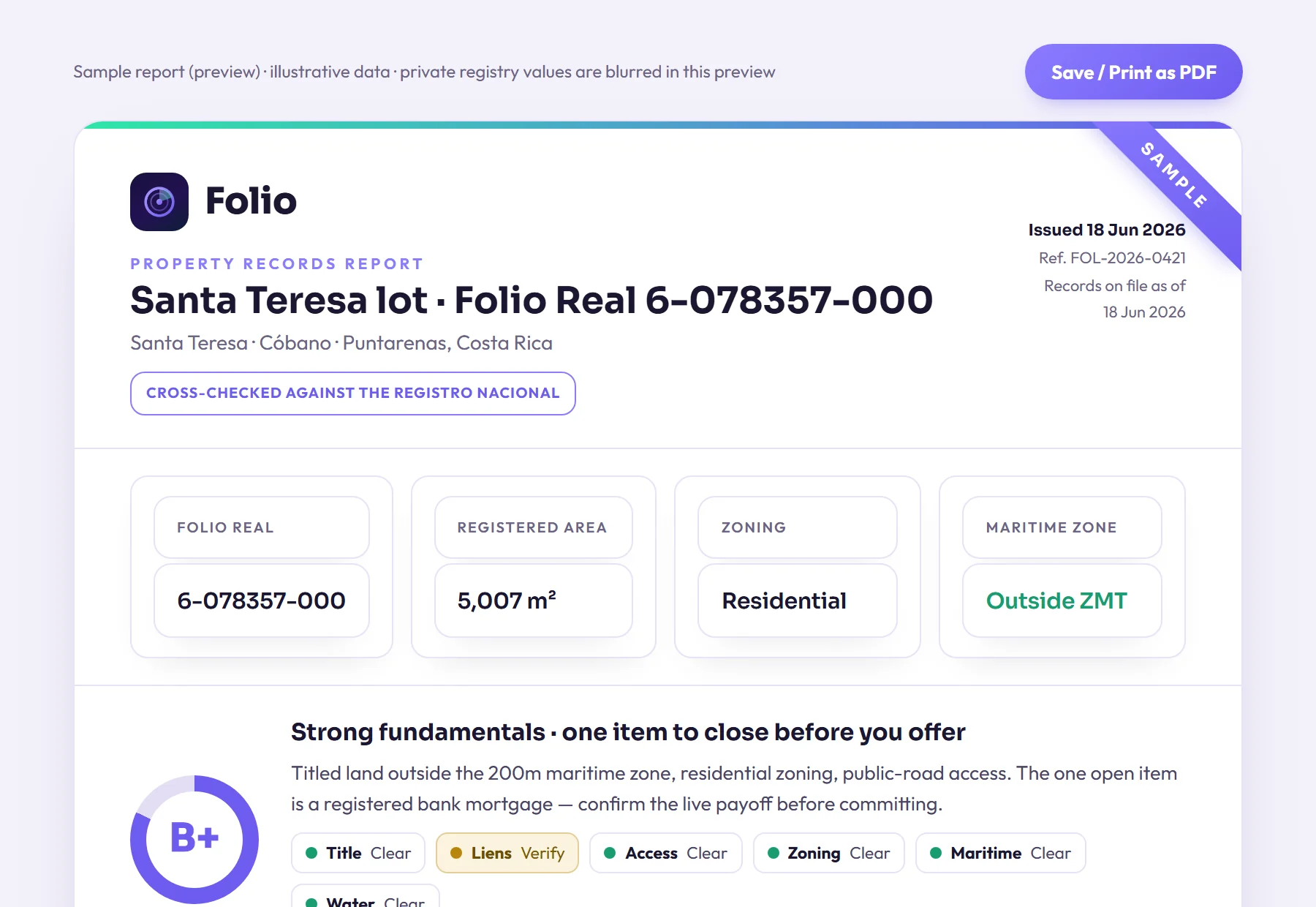
What the sample does support is a habit: read both blocks of the certificate every time, and treat any annotation as a question to answer before money moves. You can see how we present these entries in what a Folio property report includes. Folio shows what the public records say. Your attorney or notary tells you what it means for your purchase.
Know what you're buying before the deposit.
Most problems with a lot don't show up in the listing, and often the seller doesn't know about them either. Folio lets you find them now, before you pay a lawyer to start the purchase.
Frequently asked questions
What does inmovilización por inconsistencia mean in English?
It translates roughly as "immobilization due to inconsistency." It is a registry freeze recorded on a finca because the Registro Nacional flagged something in the record that does not match up. In our sample, the freeze entries cited an administrative file (expediente).
Is a frozen title the same as a lawsuit on the property?
No. A freeze is an administrative entry from the registry, while a demanda is an annotation that a court case affects the finca. They can appear on the same certificate, and in our small sample both kinds of entries showed up, so check for each separately.
How common are registry freezes on Costa Rica titles?
We cannot give a national figure. In our sample of 9 recent paid reports, 2 certificates carried an inmovilización por inconsistencia. That is far too small a sample to generalize, but it shows these entries do appear and are worth checking for.
Who can tell me if a freeze has been lifted?
A current certificación literal shows what is recorded today, and your attorney can read the cited expediente to explain its status and effect. Do not rely on a seller's statement or an older copy of the certificate.
Sources
- Registro Nacional digital services (certificaciones and registry consultations), Registro Nacional de Costa Rica
- Poder Judicial de Costa Rica, Poder Judicial
- Folio data: Registro Nacional certificates pulled for recent paid Folio reports, aggregated and anonymized.
Educational, not legal advice. Folio reports what public records show; it does not replace a licensed Costa Rican attorney, notary or surveyor. Confirm material facts with them before any transaction. Photos are illustrative.