You confirm water for a lot by identifying who would supply it (AyA, a municipality, a community ASADA, or a private well or spring) and getting written confirmation from that provider that service is available for that specific parcel. If the lot relies on a well or spring, ask your attorney to confirm the permits or concession behind it with the Dirección de Agua, and check whether groundwater rules affect the site.
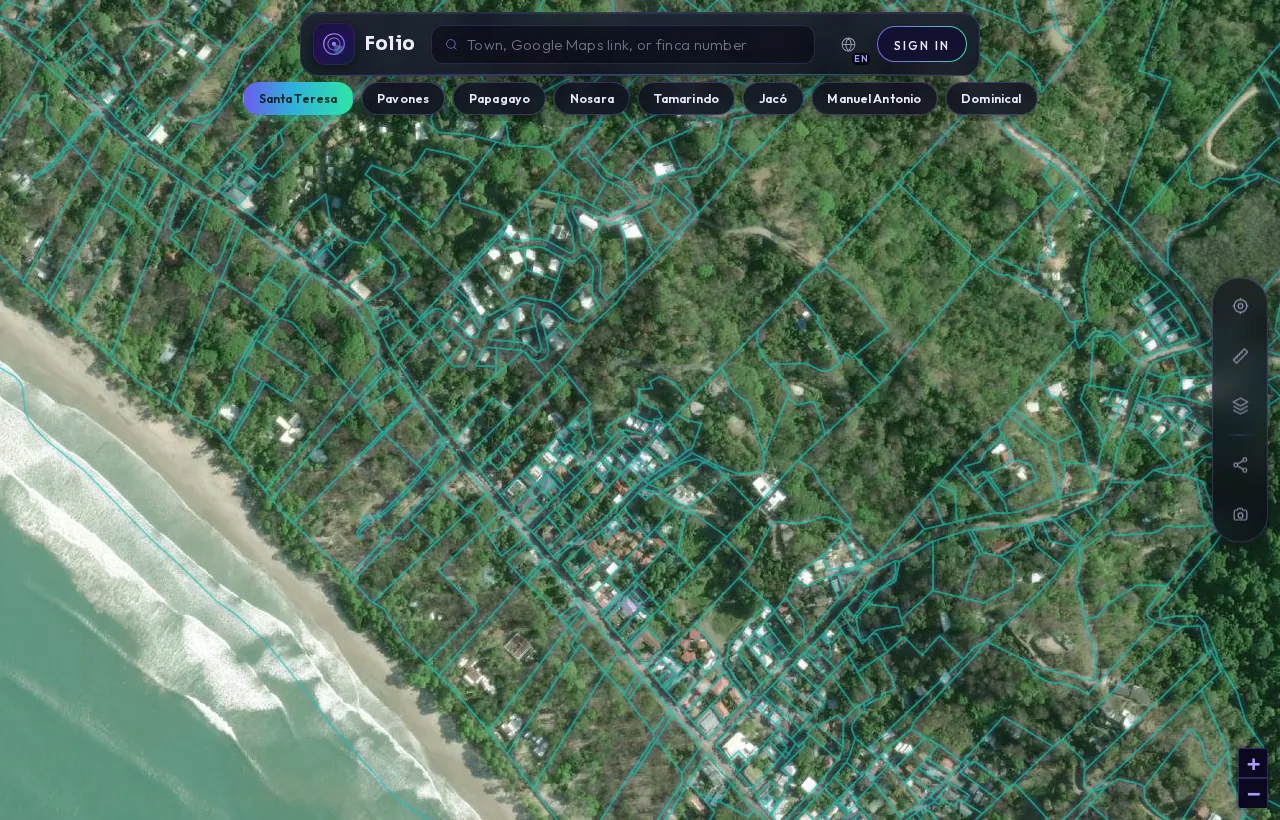
Any parcel, in the Folio app.
Search a town, a Google Maps link or a finca and Folio outlines the registered parcel from the national cadastre, with the maritime line, protected areas and water on top of it, before you call a lawyer or put down a deposit.
What does "confirming water" actually mean for a lot?
A lot has water only if a legitimate source can deliver it to that parcel, and you can document it. A pipe on the road, a neighbour's tap or a seller's assurance is not the same thing. Ask your attorney whether the municipality will require proof of water availability when you later apply for a building permit, so you are not caught out after closing.
In practice you need to answer three questions before you sign. Who supplies water in this area? Will that supplier commit, in writing, to serving this parcel? If the source is private, is it authorised? The rest of this guide walks through each one.
Who supplies water to a lot in Costa Rica?
Water service in Costa Rica comes from several kinds of operators, and the right one depends on where the lot is. The first job is to find out which one covers your parcel.
- AyA. The national water and sewer institute, AyA (Instituto Costarricense de Acueductos y Alcantarillados), runs many urban and regional systems and oversees others.
- Municipal systems. Some cantons operate their own water service.
- ASADAs. In many rural and coastal areas, water comes from an ASADA (a community water association) that manages a local system.
- Private wells or springs. Some lots depend on a pozo (well) or naciente (spring). These usually require authorisation from the state, which is a separate question from whether water physically flows.
Ask the seller which provider serves the lot, then verify it yourself by contacting that provider directly. The provider that serves the neighbourhood has not necessarily agreed to serve this particular parcel.
What is a water letter and what does it prove?
The most useful single document is a written statement from the provider confirming that water is available for the lot. It is often called a carta de agua (water letter) or a constancia de disponibilidad de agua (certificate of water availability). Our guide to the water letter in Costa Rica explains the document in detail.
Read the letter carefully. It should identify the parcel clearly, name the provider, and say what is being offered. Check for limits or conditions, such as service subject to the buyer paying for a line extension, or availability for a single home only. A letter for one dwelling may not support the subdivision or rental units you have in mind.
Also check the date. A letter issued years ago may no longer reflect what the provider can deliver, especially where demand has grown quickly. Ask your attorney whether a fresh letter is needed and how long the provider treats a letter as valid.
If the provider says no
A refusal or a letter saying capacity is not available is serious information. It can mean the system is at its limit, or that the lot sits outside the service area. Do not assume it will change. Treat it as a reason to discuss with your attorney whether to renegotiate, require the seller to solve it before closing, or walk away.
What if the lot depends on a well or a spring?
A working well on the property does not prove you are allowed to use it. In Costa Rica, water is treated as a public resource, and using groundwater or surface water generally requires authorisation. The agency responsible for water concessions and well permits is the Dirección de Agua of MINAE.
Ask the seller for the documents behind the well or spring, such as a concession, a well permit or registration, and any records of approved volume and use. Have your attorney confirm with the Dirección de Agua that the authorisation exists, is current and covers the use you plan. Domestic use for one home is a different matter from irrigation, a pool or several rentals.
Find out whether the authorisation stays with the land when it is sold or needs a transfer or new application. Ask your attorney which rule applies in your case, because the answer affects your timeline and your negotiating position. For a wider view, our guide to water rights and Costa Rica property covers what buyers must check.
See whether mapped water features touch your lot in the free Folio check.
Check it freeCan groundwater rules or land use limit the lot?
Yes. Some areas sit over aquifers considered vulnerable, and building or drilling there may face restrictions. SENARA (Servicio Nacional de Aguas Subterráneas, Riego y Avenamiento) is the agency that studies groundwater and is involved in assessing aquifer protection. Ask your attorney or engineer whether SENARA criteria apply to the site, particularly if you plan a well or a septic system.
Springs and wells can also create protection zones where building is limited. A naciente on or near the lot can reduce the area you can actually use. Look at a site plan with the source marked, and ask how far the buildable area sits from it.
Water also ties into land use. The municipality's uso de suelo (land use certificate) tells you what can be built on a parcel, and water availability may be requested in the same permit process. Ask your attorney how the two fit together for your lot, and read our guide to uso de suelo in Costa Rica so you check both together rather than separately.
Get the free Costa Rica buyer's checklist
What to ask for, what to pull from the registry and what to confirm on the map before you sign anything. One short email, no spam.
What should you ask for before signing?
Put these items into your due diligence list, and ideally make them conditions in the purchase agreement.
- The name of the water provider that serves the parcel, confirmed directly with that provider.
- A current written letter of water availability that identifies this specific lot and states any conditions.
- If there is a well or spring, copies of the concession or permit, checked by your attorney with the Dirección de Agua.
- A site plan showing where the water line, meter, well or spring sits in relation to the boundaries.
- Confirmation of any costs you would bear, such as extending a line, installing a meter or joining an ASADA.
- Your attorney's view on whether any authorisation transfers with the sale.
- A check of whether groundwater or spring protection rules restrict the area you want to build on.
A practical tip: visit the provider's office yourself or through your attorney, and ask about current capacity, planned line extensions and any disputes affecting service in the area.
What can public records tell you about water, and what can't they?
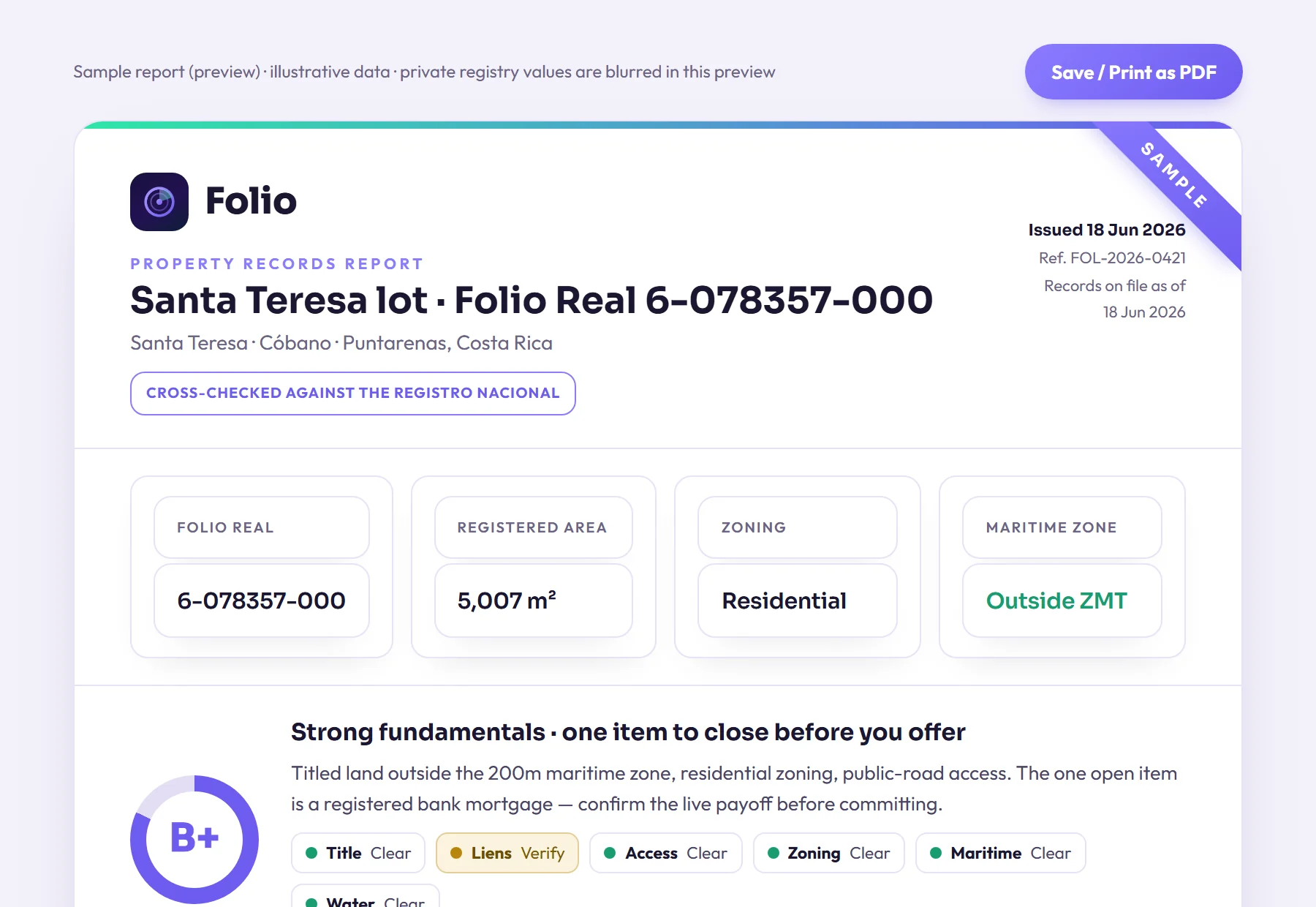
Public map layers can show whether a parcel sits near rivers, springs, protected areas or other mapped features, and they help you spot questions early. The Folio free check looks at official cadastre, maritime zone, protected areas and water layers for a parcel. Folio's $29 verified report is a human-checked records search that covers water rights among other items, delivered within 24 hours.
Records still have limits. A map layer cannot tell you whether an ASADA has capacity this year, and a registry search cannot replace a provider's written commitment. Use records to frame the right questions, then get the answers from the provider, the Dirección de Agua and your attorney or notary, who advises on what the documents mean for your purchase.
Which warning signs should slow you down?
- The seller offers a verbal promise of water but no letter.
- The water letter names a different parcel, an old owner, or is many years old.
- Water comes through a hose or line crossing a neighbour's land with no written easement.
- A well exists but nobody can produce a permit or concession.
- The provider says the area is at capacity or outside its service zone.
- The listing describes the lot as "ready to build" but the uso de suelo and water documents have not been requested.
None of these automatically means the deal is dead. They mean the question stays open until someone documents the answer, so ask your attorney how to have the seller resolve them before money changes hands.
Know what you're buying before the deposit.
Most problems with a lot don't show up in the listing, and often the seller doesn't know about them either. Folio lets you find them now, before you pay a lawyer to start the purchase.
Frequently asked questions
Is a water meter on the lot proof that water is available?
Not by itself. A meter shows that a connection existed at some point, but you still want written confirmation from the provider that service is active and available for this parcel and your intended use. Check whose name the account is in and whether any debts are attached.
Can I just drill a well if the lot has no water service?
Not freely. Using groundwater generally requires authorisation from the Dirección de Agua, and some areas have groundwater protection limits studied by SENARA. Ask your attorney to confirm what permits apply before you count on a well as your water source.
What is an ASADA and why does it matter to buyers?
An ASADA is a community water association that runs a local water system, common in rural and coastal Costa Rica. If an ASADA serves the area, it is the provider you would ask for the water availability letter, so its capacity and rules can affect whether you can build.
Should water be a condition in my purchase agreement?
It is sensible to ask your attorney to make written water availability, and any well or spring authorisation, a condition before closing. Your attorney can explain how such a condition would work if the provider refuses service or the permits cannot be confirmed.
Sources
- AyA, Instituto Costarricense de Acueductos y Alcantarillados, AyA
- SENARA, Servicio Nacional de Aguas Subterráneas, Riego y Avenamiento, SENARA
- Dirección de Agua (MINAE), MINAE, Dirección de Agua
Educational, not legal advice. Folio reports what public records show; it does not replace a licensed Costa Rican attorney, notary or surveyor. Confirm material facts with them before any transaction. Photos are illustrative.